
MonoCore™ Protein G
Protein G monolith column
Supplied for research and process development.
Protein G monolith column for antibody capture across broad IgG subclasses — including murine IgG1 and human IgG3 and formats that Protein A binds weakly. Cleaning conditions are available on request.
Specifications
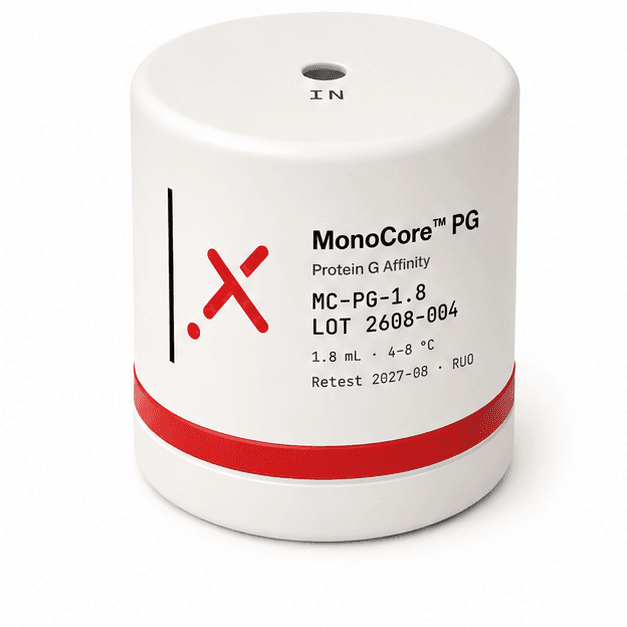
MonoCore™ Protein G is a modified cellulose monolith with a 15 µm (standard), custom 10–150 µm on request standard channel size, supplied as pre-assembled 1.8 mL and 5.4 mL capsules with UNF 10/32 ports. Larger formats are available on request, and the capsule connects directly to a standard FPLC system.
- Chemistry
- Protein G
- Matrix
- Modified cellulose
- Format
- 1.8 mL · 5.4 mL · larger on request
- Channel size
- 15 µm (standard), custom 10–150 µm on request
- Connectors
- Standard FPLC (UNF 10/32)
Detailed performance data are available on request.
Frequently asked questions
Do I need to filter the feed before loading?
- Yes — the feed has to be clarified, as for any chromatography step. Centrifugation followed by depth filtration is the usual route, and it is what protects a column from the debris that drives back-pressure up over a run. Whether you add a 0.22 or 0.45 µm step immediately before the column is a separate decision: it matters most where the narrowest part of the flow path is the gap between packed particles. A 15 µm open channel leaves more margin there, but a feed that has been standing and has begun to precipitate will still cause trouble. Match the filter train to the feed you actually have rather than to the one from the last project — every filtration stage also costs you product through adsorption.
When is Protein G the better ligand?
- Where Protein A binds weakly: mouse IgG1, human IgG3, rat, goat and sheep antibodies, and some Fab and Fc-fragment formats. For human IgG1, IgG2 and IgG4, Protein A remains the default.
Does the ligand bind albumin?
- Native Protein G does. The ligand here is recombinant Protein G with the albumin-binding domain removed, which matters when the feed contains serum.
What elution conditions are used?
- Low pH. Conditions in common use sit around pH 2.5–3.0 — somewhat lower than Protein A usually needs — though that is a description of the ligand chemistry generally, not a specification of this product; the conditions we characterise under come with the datasheet depending on subclass, with immediate neutralisation into 1 M Tris-HCl pH 8.5.
How is the capsule cleaned?
- The cleaning conditions for MonoCore™ Protein G are available on request. Those figures describe the housing and the matrix, not the ligand. On an affinity capsule the ligand is the sensitive component and sets the cleaning conditions; protein ligands lose capacity in strong alkali. The characterised conditions come with the datasheet.
Which formats are available?
- 1.8 mL and 5.4 mL, larger on request, with UNF 10/32 coned ports for standard FPLC systems.
Related products
- AEX
MonoCore™ Q
Strong and weak anion exchange in monolith format — for capture and impurity removal in AAV polishing, pDNA capture, and host-cell-protein clearance. Resolution that lets you use it for capture, not only polishing.
- CEX
MonoCore™ S
Strong and weak cation exchange in monolith format — for mAb and bispecific polishing. Resin-class peak resolution at membrane-class throughput.
- HIC
MonoCore™ HIC
Hydrophobic interaction chromatography (HIC) in monolith format — available with Butyl or Phenyl ligands. Frequently used for aggregate removal, with tight aggregate–monomer separation at process flow rates.